

OMTech G3

- 1: 30W or 50W Fiber laser
- 2: Focus Made Simple
- 3: Fast Batch Processing
- 4: Desktop split and handheld setups
- 5: One laser three ways to work
PRICE
-
 OMTech G3 $1799.99
View Offer -
 OMTech G3 $1799.99
View Offer
PROS
- True 3-in-1 flexibility
- Competitive Q-switched performance
- Good software compatibility
- Broad application coverage
CONS
- Not a MOPA laser
- Not plug-and-play
- Support is ticket-based
- Fit and finish are value-tier
Most fiber laser engravers are built around a single, implicit assumption: the work comes to the machine. The OMTech G3 challenges that assumption directly. It is a Q-switched fiber laser that can sit on a desktop, split apart into a separate processing unit and main body, or be carried to the workpiece as a handheld marking head — all with the same 150 × 150 mm marking field. The pitch is flexibility without compromise. The reality, based on the spec sheet and what the broader OMTech ownership experience reveals, is more nuanced but genuinely interesting.

The 3-in-1 concept: more than a marketing hook
The G3’s headline feature is its three operating modes: desktop, split, and handheld. Desktop mode is self-explanatory — a conventional galvo fiber layout for bench work. Split mode separates the processing unit from the main body, which matters more than it first appears. Fiber laser work often revolves around jigs, fixtures, and rotary axes, and a monolithic head unit can get in the way of that infrastructure. Splitting the processing head from the body lets you build the laser around the fixture rather than rebuilding the fixture around the laser.
Handheld mode is the most distinctive. A quick-release head turns the G3 into a portable marking tool for large, fixed, or immovable workpieces — think chassis frames, installed signage, or heavy machinery that will never see the inside of a workshop. Crucially, the handheld head retains the full 150 × 150 mm marking field, so “portable” does not mean “reduced”. That is a meaningful spec, because many handheld fiber systems shrink the field to keep the head manageable.
Performance: deep when needed, fine when it counts
The G3 is offered in 30W and 50W Q-switched configurations, both delivering up to 10,000 mm/s marking speed and 3 mm maximum engraving depth, with a minimum line width of 0.06 mm. Those numbers position it as a capable general-purpose metal marker rather than a dedicated deep-engraving or high-precision micro-marking specialist.

The 0.06 mm line width is fine enough for small text, barcodes, and detailed logos, and the 10,000 mm/s ceiling puts it in the “fast galvo” category where marking jobs feel near-instantaneous for logos and serial numbers. The 3 mm depth claim is more workload-dependent: achieving 3 mm in stainless steel typically requires multiple passes and careful parameter tuning, whereas 3 mm in softer metals or in a single deep-engraving pass on tool steel is more attainable. The G3 is not a MOPA laser, so it is not the tool for color marking on stainless steel or annealing-driven surface effects. It is a standard Q-switched fiber source aimed at the core metal-marking jobs — deep engraving, contrast marking, and high-throughput serialization.
Software and workflow: LightBurn is the real story
The G3 runs on OMTech Mark or LightBurn on both Windows and macOS, with compatibility for rotary axes and conveyors. LightBurn support is the more consequential of those two, because LightBurn has become the de facto standard interface for galvo fiber work, and macOS compatibility removes a long-standing pain point for fiber lasers that were once Windows-only. Rotary and conveyor compatibility extends the machine beyond flat-plate marking into rings, cylinders, and batch-fed production — the kind of expansion that turns a marking tool into a small production cell.
The OMTech reality check
No honest review of an OMTech machine can ignore the brand’s ownership pattern. OMTech’s value proposition is straightforward: real laser sources and working hardware at prices that undercut Western-brand equivalents substantially. But the trade-off is well documented. Buyers routinely report that the machine arrives mostly built but not fully dialed in, with setup, optic checks, and parameter tuning left to the owner. Support runs through email tickets with response times of one to three business days, and while warranty parts are generally shipped without excessive friction, there is no live phone support for instant troubleshooting.

For the G3 specifically, the handheld head introduces additional complexity that desktop-only fiber lasers do not face. A quick-release head with an integrated marking field is a mechanical and optical interface that has to survive repeated docking and undocking. Early user feedback on OMTech fiber systems has flagged intermittent power-supply failures and connection-drop issues, though these reports are not G3-specific and appear to vary by unit. The practical takeaway is not that the G3 is unreliable, but that it rewards a buyer who is willing to verify the machine thoroughly on arrival, test all three modes under load, and keep support conversations documented.
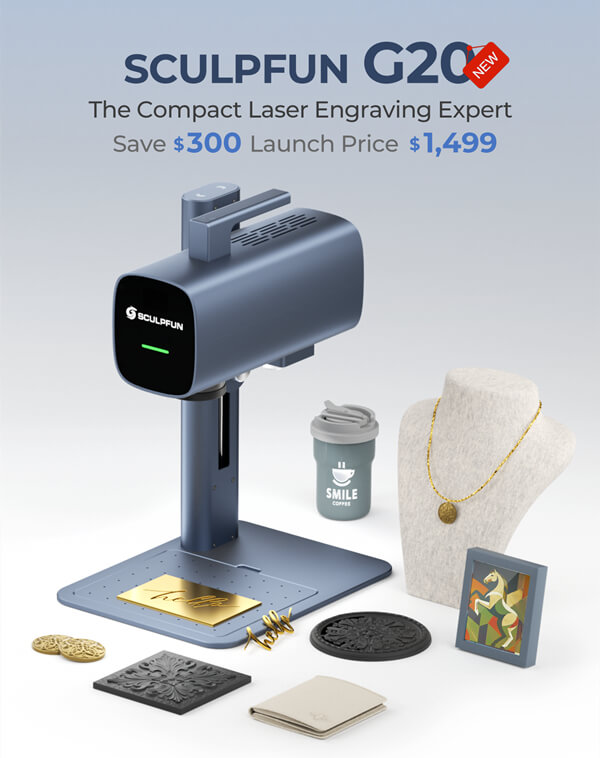
OMTech G3 vs. Sculpfun G20: Spec and Positioning Comparison
| Feature | OMTech G3 | Sculpfun G20 |
|---|---|---|
| Laser Type | Q-Switched Fiber (non-MOPA) | 1064 nm Fiber Laser (Galvo) |
| Power Options | 30W | 20W |
| Core Design Philosophy | 3-in-1 physical reconfiguration: desktop, split, and handheld | Compact, fixed desktop galvo system |
| Operating Modes | Desktop / Split (processing unit separates from main body) / Handheld (quick-release head) | Fixed desktop only |
| Standard Marking Field | 150 × 150 mm (retained even in handheld mode) | 150 × 150 mm |
| Field Expansion | Not specified | Extendable to 350 × 150 mm via Slide Extension Kit |
| Max Marking Speed | 10,000 mm/s | 10,000 mm/s |
| Max Engraving Depth | 3 mm | 1.5 mm (manufacturer claim) |
| Spot Size / Min. Line Width | Min. line width 0.06 mm | Spot size approx. 0.01 mm |
| Color Marking (Stainless/Titanium) | No (Q-switched source lacks MOPA control) | Yes (via frequency-controlled surface oxidation; 30–60 kHz range) |
| Focus System | Not specified in available material | Motorized Z-axis with dual red-dot alignment |
| Software | OMTech Mark / LightBurn (Windows & macOS) | SGD Laser / LightBurn Pro (Pro license required) |
| Rotary Support | Compatible | Compatible with RA Pro Max rotary |
| Enclosure / Safety | Open frame (no built-in enclosure specified) | Open stand, Class 4; 1064 nm safety is user’s responsibility |
| Approx. Weight | Not specified in available material | 6.9 kg |
| Approx. Price | $1,799 | $1,499 |
| Key Strength | Physical deployment flexibility; deeper engraving ceiling; split and handheld modes reach immovable workpieces | Color marking; motorized Z; expandable field; compact footprint; lower entry price |
| Key Limitation | Non-MOPA (no color marking); handheld quick-release interface’s long-term durability is unproven; OMTech support is primarily ticket-based | Only 20W, so depth is limited; no enclosure; color palette is narrower than true MOPA; LightBurn Pro adds cost |
Summary
The OMTech G3 is one of the more genuinely differentiated fiber lasers in the sub-premium segment. The 3-in-1 design is not a gimmick: split mode solves a real fixture-access problem, and handheld mode with a full 150 × 150 mm field is a legitimate capability that most desktop fiber lasers simply do not offer. The performance envelope — 3 mm depth, 0.06 mm line width, 10,000 mm/s — is competitive for a Q-switched source, and LightBurn with macOS support makes it easier to integrate into a modern workflow than many fiber lasers at this price.
What you are buying is flexibility and raw capability per dollar, not refinement. If you can absorb the setup effort, test the handheld head rigorously, and treat support as a ticketing process rather than a hotline, the G3 delivers a combination of reach and precision that is difficult to replicate with a conventional single-configuration fiber engraver.
SPECS
Product Details
| Specification | Laser Type: Q-Switched Fiber Laser Laser Power: 30W / 50W Optical Marking Field: 150 × 150 mm Max. Marking Speed: 10,000 mm/s Deep Engraving Depth: 3 mm Minimum Line Width: 0.06 mm Marking Precision: ±0.002 mm |
REVIEWS
More Products from OMTECH


Copyright © 2015 - 2026 Priceboon.com. All Rights Reserved.