

The desktop manufacturing landscape is about to shift. Bambu Lab, the Shenzhen-based company that revolutionized consumer 3D printing, has just announced its first standalone laser engraving and cutting device: the Bambu Lab R1.
On August 13, 2026, Bambu Lab quietly unveiled a teaser landing page for the R1, signaling its official entry into the laser processing market. The company, founded in 2020 by former DJI engineers led by Ye Tao, has grown from a successful Kickstarter campaign in 2022 into one of the world’s largest suppliers of desktop 3D printers. Now, it’s applying that same formula to an entirely new category.
From Additive to Subtractive Manufacturing
Until now, Bambu Lab had only offered laser functionality as an expansion module for its 3D printers—most notably the H2D and H2S models, which could be equipped with 10W or 40W diode laser modules operating at 455nm wavelength. The H2D, launched in 2025, was positioned as a “4-in-1” personal manufacturing hub combining 3D printing, laser engraving/cutting, CNC blade cutting, and pen plotting.
The R1 represents a fundamental departure. It is a dedicated, standalone device—not an accessory, not a bolt-on module. As one community member put it: “Laser engraver not located in a damn printer? Sounds good”. The move addresses a practical pain point that many H2D users have experienced: the cumbersome transition between 3D printing and laser operations, which requires extensive cleaning to prevent residue from contaminating the printer’s delicate mechanics.
What We Know About the R1
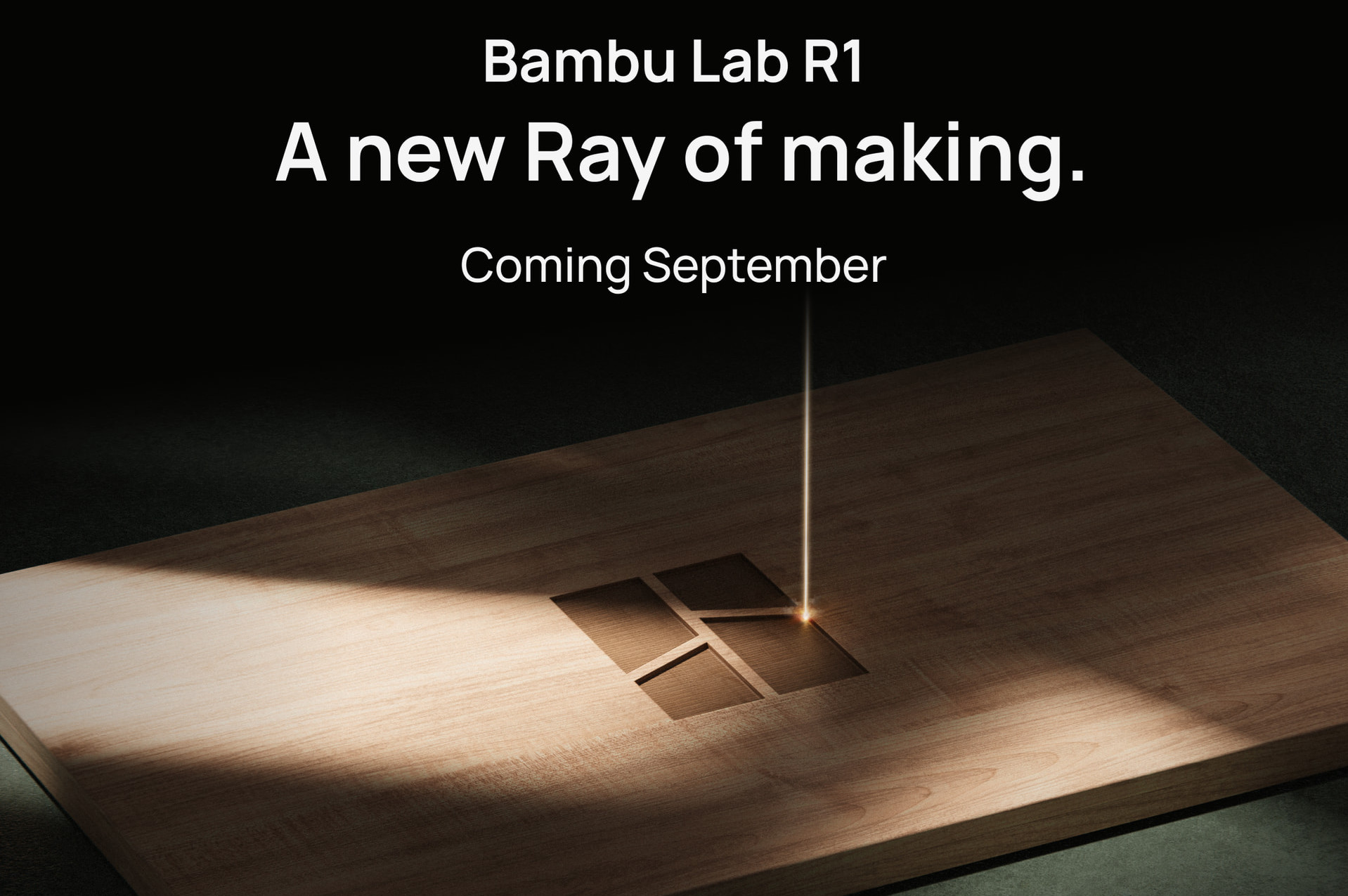
Bambu Lab has not yet published specific technical specifications. The teaser page—accessible at bambulab site—features a laser-etched Bambu Lab logo with the tagline “A new ray for your ideas” and promises a September 2026 launch. A full product page with complete specifications is expected by the end of August, with the first press review units shipping after August 20 in limited quantities. Pre-sales will begin in September.
The industry is already speculating. Many observers believe the R1 will feature a CO₂ laser, given the device’s positioning as a standalone desktop unit targeting makers and small businesses. CO₂ lasers are generally more powerful and versatile for cutting thicker materials than diode lasers, which would align with Bambu Lab’s reputation for delivering industrial-grade performance in consumer-friendly packages.
The company’s stated goal is clear: to create multiple tools for the hobbyist workshop, all sharing the same philosophy of innovation, reliability, intuitive operation, and attractive design at competitive prices. CEO Ye Tao, a passionate model builder, is personally invested in laser engraving and CNC machining.
A Market Ripe for Disruption
Bambu Lab’s entry comes at a pivotal moment. The consumer laser engraving market is experiencing explosive growth. Industry data shows the global consumer laser engraver market reached approximately $800 million in 2024 with 872,900 unit shipments. By 2025, it had surpassed $1.2 billion, and projections for 2026 range from $1.5 billion to $1.8 billion. The broader laser processing market—including industrial applications—was valued at $2.63 billion in 2025 and is expected to reach $4.1 billion by 2034.
Yet despite this growth, the consumer laser market remains relatively small compared to 3D printing, which reached $21.9 billion globally in 2024. The market has been constrained by three primary barriers: high prices (entry-level units cost thousands, professional models tens of thousands), steep learning curves (open-source systems lacking intelligent assistance, requiring users to assemble and calibrate themselves), and low-end products that sacrifice performance for affordability.
The Competitive Landscape: xTool’s Dominance
The consumer laser market currently has a clear leader – xTool, a brand under Makeblock, commands approximately 47% global market share by GMV as of the first nine months of 2025. The company generated over RMB 2 billion ($276 million) in annual revenue and has filed for a Hong Kong IPO. Its Black Friday single-day sales exceeded RMB 100 million.
Other players include LaserPecker (nearly RMB 500 million in annual sales, focusing on handheld portable devices), Ortur (entry-level models starting at $399), and emerging brands like YuanYing Technology and Starhan Laser.
The timing of Bambu Lab’s announcement may not be coincidental. Within minutes of the R1 teaser going live, xTool reportedly announced its own upcoming X1 model, positioning it as “a new generation of laser technology”. The competitive dynamic is already heating up.
Can Bambu Lab Replicate Its 3D Printing Success?
Bambu Lab’s core thesis is that the laser engraving market today resembles the 3D printing market of a few years ago: fragmented, technically challenging, and in need of a company that can deliver plug-and-play reliability. The company’s competitive advantages—software algorithms, user experience design, and ecosystem integration—are directly transferable to laser processing.
Community reaction has been largely positive, with users expressing particular interest in Bambu Lab’s software and ecosystem integration. One forum member noted: “XTool has good machines, but their software is terrible. Creality has decent software, but their machines are lacking”. Another observed: “Bambu doing their own dedicated laser style machine is a nice way to protect your customer from looking around”.
However, there are fundamental differences between the two categories. As one industry investor pointed out: “3D printing is ‘from nothing to something’—users print a three-dimensional object, which has stronger novelty and shareability. Laser processing is ‘from something to refined’—processing on existing materials, with higher practical value but weaker buzz”. This could affect the speed and efficiency of market education.
What’s at Stake
The R1 represents more than just a new product—it’s a strategic pivot. Bambu Lab has already achieved a valuation exceeding $10 billion with revenue surpassing RMB 6 billion ($830 million). The company has sold over 1 million units cumulatively in the domestic market alone. Now, it’s betting that it can replicate that success in an adjacent but distinct category.
The company’s philosophy, as articulated in its announcement, is “ONE MORE TOOL. More power. Made simple”. Whether that simplicity can translate into market share against an entrenched leader like xTool remains to be seen.
What is certain is that the consumer laser engraving market is about to get a lot more interesting. The R1’s full specifications will be revealed later this month, and pre-orders will open in September. The industry is watching closely—and for good reason. Bambu Lab has a track record of turning niche hobbies into mainstream movements. If it can do the same for laser engraving, the R1 may be remembered as the moment the category went mainstream.